Family Crest vs Coat of Arms: What's the Difference?
Ask ten people to describe a family crest and most will sketch a shield. That is the giveaway. The shield is not the crest, and the crest is not the coat of arms — it is one component of it, sitting at the top where you might not have looked. The mix-up is so common that it has become the standard shorthand, printed on souvenir mugs and tea towels across the country. It is also the reason so many beginners feel lost when they start digging into their own family's heraldry. Once you can name the parts, everything else falls into place.
What a coat of arms actually is
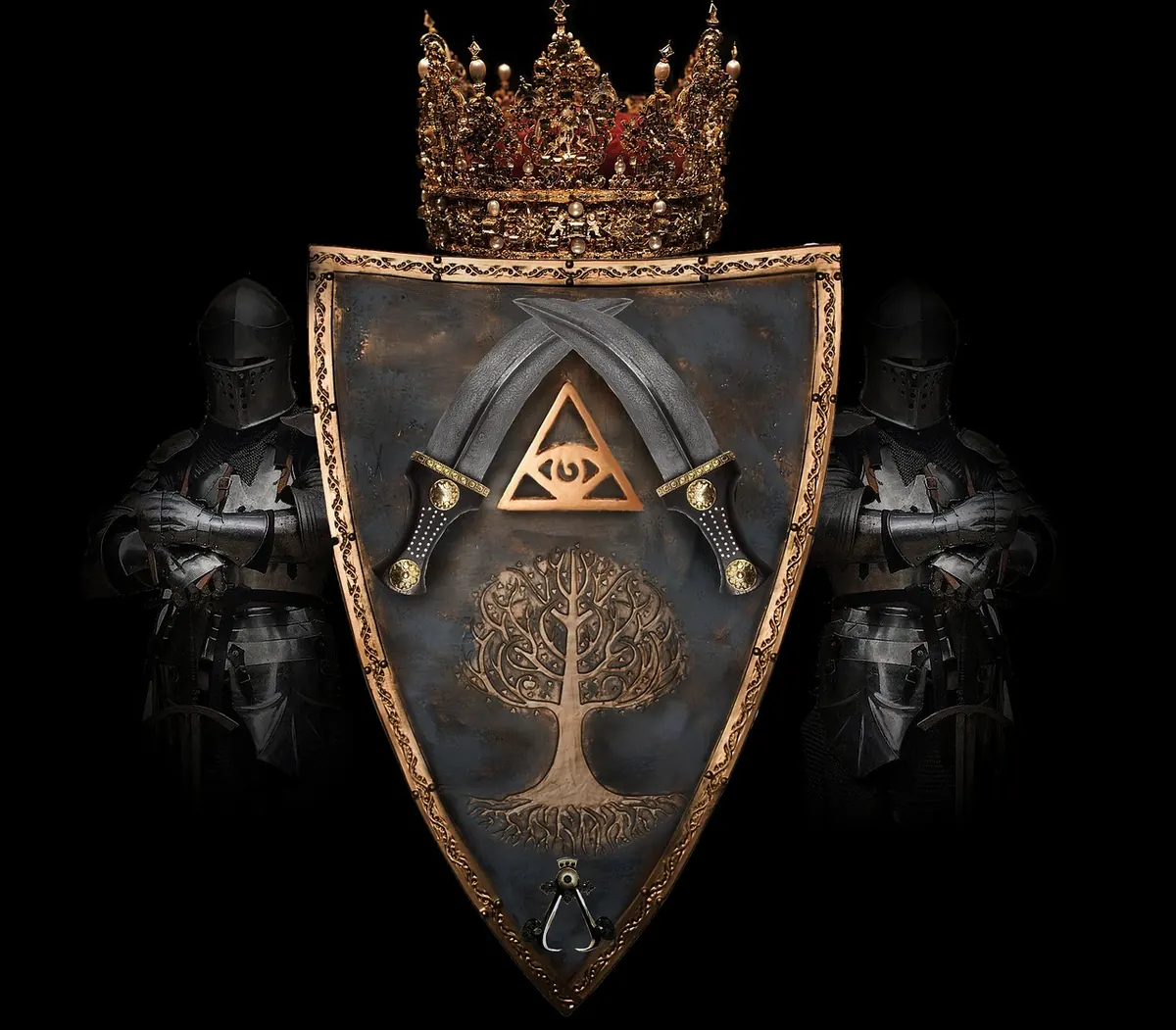
A coat of arms is the complete design. Heralds call it an achievement of arms, and it takes in the shield plus every element arranged around it. Think of it as a whole document rather than a single symbol: the shield carries the main identification, while the surrounding pieces add rank, history and personality.
The word "coat" is literal. Medieval knights wore a surcoat over their armour, and the design painted on it let people recognise them in the middle of a melee. The heraldry grew out of that practical need for recognition on a battlefield, which is why the shield remains the centre of the composition.
The parts of a full coat of arms
Most arms share the same skeleton, even when the detail varies wildly. Working from the outside in:
- Shield (also called the escutcheon) — the central surface bearing the main design.
- Helm — the helmet above the shield; its style and angle can indicate rank or nationality.
- Mantling — the draped, often ragged cloth flowing from the helmet, usually in the two principal colours of the arms.
- Wreath or torse — the twisted band of those same two colours that sits on top of the helm.
- Crest — the figure standing on the wreath, above everything else.
- Motto — a scroll, often below the shield, though not every armiger uses one.
- Supporters — the figures holding up the shield on either side, granted to relatively few people and to many corporate bodies.
- Compartment — the base, often a grassy mound, on which supporters stand.
Not every coat of arms has all of these. Plenty of personal arms consist of a shield, helm, mantling, wreath and crest, and stop there.
The shield: where identification really happens
If you want to know whose arms you are looking at, the shield answers the question. Its design — the field, the charges, the arrangement of colour and metal — is what makes those arms distinct from any other. Heralds describe the shield in a formal language called blazon, and a correctly written blazon identifies one specific set of arms and nothing else.
Two families can hold entirely different shields while having surprisingly similar crests. A boar's head here, a boar's head there: the crest alone proves very little. That is precisely why the shield comes first in any serious identification.
So what is a crest, exactly?
The crest is the emblem that sat on top of a knight's helmet. It was physical, three-dimensional and often impractical — carved from light wood, boiled leather or stiffened cloth, and sometimes repaired after tournaments. Common forms include a beast's head erased, a demi-lion, a hand gripping a sword, a wyvern, a bird, or a cubit arm. In time the crest became the most personal and portable part of the arms, which is why it was adopted for seals, signet rings and badges.
Here is the trap. A rearing lion on the shield is not a crest; it is a charge on the shield. The crest is the separate figure perched above the helmet. If you can see a wreath of twisted colours directly beneath it, you have found the crest.
Why "family crest" is such a stubborn phrase
The giftware trade cemented the confusion. Souvenir shops sell "family crest" plaques for hundreds of surnames, usually lifted from nineteenth-century armorials, and the wording stuck. There is also a legitimate Scottish tradition at work: a clansman may wear a crest badge, which shows the chief's crest encircled by a strap and buckle. That strap signals allegiance rather than ownership — it says "I follow this chief", not "these are my arms".
Does your surname have a crest or coat of arms?
No. Arms are granted to individuals and descend by rules of inheritance. They are not attached to surnames, and sharing a surname with an armiger does not entitle you to their arms. In practice this means two unrelated families called Fletcher, or Baker, or Kerr may each hold completely different arms, or none at all.
Grants are made by different bodies depending on where you are: the College of Arms for England, Wales and Northern Ireland; the Court of the Lord Lyon for Scotland; the Chief Herald for Ireland. Rules on use also vary, and enforcement is notably stricter in Scotland than elsewhere. If you need certainty about your own position, take advice from the relevant heraldic authority rather than a website selling prints.
How to read a coat of arms you have found
- Start with the shield and describe it in plain words before reaching for heraldic terms.
- Move outwards: helm, wreath, crest. Note anything unusual, such as a crest-wreath in different colours from the mantling.
- Check for supporters. Their presence usually points to a grant to a corporate body or to someone of significant rank.
- Record the motto, but treat it as a clue rather than proof — mottos are not unique to one family.
- Write down where the image came from. A Victorian armorial or a modern print is evidence of somebody's arms, not of your descent from them.
A quick word on blazon
Blazon always describes the shield first and the crest last, as a separate clause. Something like "Argent, a chevron gules between three boars' heads couped sable, and for a crest a boar's head as in the arms" tells you plainly that two distinct things are being described. If you learn to read that structure, the crest-versus-arms question stops being confusing.
Practical next steps
If your aim is to find out whether arms exist for your family line, the work starts with genealogy rather than heraldry. Trace backwards through parish registers, census returns, wills and probate records until you can identify a specific ancestor in a specific place. Then approach the appropriate heraldic authority with what you have.
If you simply want something of your own, you have two honest options: petition for a new grant of arms, or commission or design a personal emblem and present it as exactly that — an emblem, not an inherited crest. Heraldry rewards accuracy. Getting the vocabulary right is the first step towards finding out what, if anything, belongs to your family.
This is general information about heraldic practice, not legal advice. For anything affecting your rights or a formal claim, consult the relevant heraldic authority or a solicitor.
Photo: OneGo / Pixabay

City of London Livery Companies: A Heraldic Tour
From the Mercers' crowned maiden to the Fishmongers' mermen, the City of London's livery companies carry...

Seasonal Heraldry: Christmas Symbols in Coats of Arms
Holly, oak, stars and candles: how wintry and Christmas-themed charges appear in coats of arms, how to...